 Skip to content

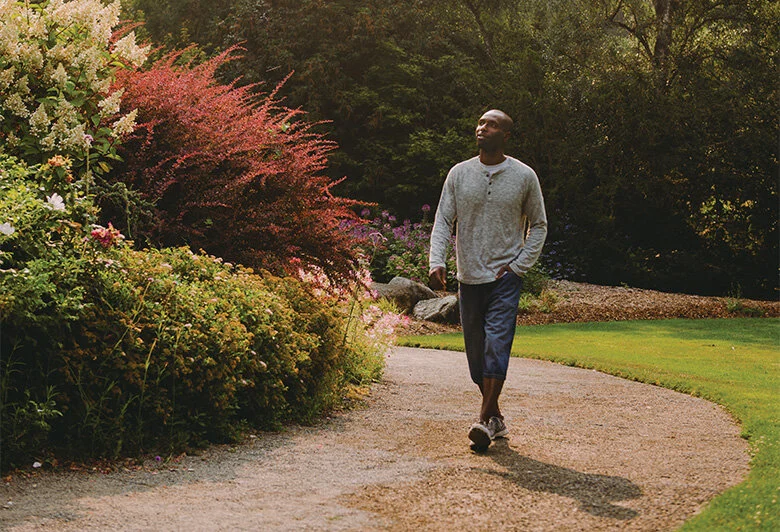
I was introduced to mindfulness shortly after grad school, though it took me a couple of different doors to really walk through it.
The first was Deepak Chopra and Oprah’s 21-day meditation series back in 2016. Every day, I’d sit down, focus on my breath or a mantra, and notice something simple but profound: when you’re fully anchored in the present moment, it’s almost impossible to spiral into the past or worry about the future. Your mind can really only hold one place at a time.
The second door was a book, Peace Is Every Step by Thich Nhat Hanh. This is where mindfulness stopped being something I only did on a cushion and became something I could bring into everything. Mindful walking. Mindful driving. Mindful showering, where I’d actually notice the water temperature, the sound, the smell of the soap. Mindful eating, where I learned to slow down and really see the color and texture of my food, which, it turns out, also helps digestion. Even mindful dishwashing and cooking. Almost any activity can become an anchor back to now if you bring your full attention to it.
What I didn’t fully understand back then was why it was working so well on my stress. Now, after years of using these practices with clients, I want to share both the personal side and the science, because they tell the same story from two different angles.
What’s Actually Happening in Your Brain
Mindfulness isn’t just a feel-good idea; it’s one of the most researched practices in mental health science. A landmark study out of Harvard-affiliated Massachusetts General Hospital, led by neuroscientist Britta Hölzel, put people through an eight-week Mindfulness-Based Stress Reduction (MBSR) program and scanned their brains before and after. The results were striking: participants who practiced mindfulness for an average of just 27 minutes a day showed measurable shrinkage in the amygdala, the brain’s fear and stress-response center, and the degree of that shrinkage directly matched how much less stressed they reported feeling. At the same time, gray matter density increased in the hippocampus, the region tied to learning, memory, and emotional regulation.
In plain terms, consistent mindfulness practice physically changes the structure of your brain in eight weeks. It turns down your fight-or-flight system and strengthens the parts of your brain responsible for calm, clarity, and self-awareness.
The clinical research backs this up just as strongly. A randomized controlled trial on MBSR for people with diagnosed anxiety disorders found medium to large improvements in anxiety symptoms and a large improvement in depression symptoms among those who completed the program, with the gains still holding six months later. Across dozens of other trials in cancer patients, cardiac patients, healthcare workers, and more, the pattern repeats: mindfulness consistently and measurably reduces symptoms of anxiety, depression, and chronic stress.
Turning Everyday Life Into a Practice
Here’s what I want you to take from both the research and my own experience: you don’t need an hour of silent meditation to benefit. Mindfulness is simply the practice of being fully present with what’s in front of you, using your senses as the anchor. That means you already have dozens of opportunities a day to practice.
With clients, one of my favorite ways to teach this is what I call a mindful eating exercise. I’ll have a client pick their favorite candy or snack, and before they eat it, we slow all the way down. What does it look like? What’s the texture? What do you notice when you smell it? Then, as they eat it, we notice the taste, the sound, the way it changes in their mouth. By the end, they’re not thinking about anything else they’re completely in the present moment, often for the first time in a while.
Another tool I use often, especially with clients navigating PTSD, social anxiety, or general stress, is a hand-tracing meditation. You trace up and down each finger slowly with the opposite hand, breathing deeply as you go. It’s simple, it’s accessible, and clients consistently tell me it’s become something they return to on their own, because they can do it anywhere in a waiting room, before a hard conversation, or in the middle of a panic moment.
I also teach mindful color walks: taking a coloring book to the park and letting color and nature hold your attention at the same time. And gratitude writing down three things you’re grateful for each day, ideally paired with something sensory like mindfully sipping your morning tea or coffee is one of the most consistently transformative practices I’ve seen, both in my own life and in my clients’ lives. It shifts you out of a scarcity mindset and into one of abundance, simply by redirecting your attention to what’s already here.
The Real Takeaway
You don’t need to overhaul your life to access the benefits of mindfulness. You need to choose one ordinary moment in your day your coffee, your shower, your walk to the car and give it your full attention. Do that consistently, and the research suggests your brain will begin to change in ways that measurably reduce anxiety, depression, and stress. That’s not a spiritual claim. That’s neuroscience.
Sources: Hölzel, B.K., et al. (2011), “Mindfulness practice leads to increases in regional brain gray matter density,” Psychiatry Research: Neuroimaging, as reported by Harvard Gazette and Harvard Health Publishing; Kim, B., et al., randomized controlled trial of MBSR for anxiety disorders (PubMed).