 Skip to content
If you’ve ever tried to meditate, sat there for ninety seconds, gotten frustrated that your mind wouldn’t stop, and decided “I’m just not a meditation person,” I want you to know that almost everything about that experience was based on a misunderstanding of what meditation actually is. Let’s clear up the biggest myths, one at a time.
Myth #1: You Have to Clear Your Mind Completely
This is probably the number one reason people quit before they start. Meditation was never about achieving a blank, thoughtless mind. It’s about becoming an observer of your thoughts instead of getting swept up in them.
Here’s something that might make you feel a lot better: research out of Queen’s University in Canada, using brain imaging to track what researchers call “thought transitions,” found that the average person has around 6,200 distinct thoughts per day. Your brain is built to generate thought after thought after thought that’s simply what a healthy, functioning mind does. So when you sit down to meditate and thoughts keep showing up, that’s not you failing at meditation. That’s your brain working exactly as it should.
The actual practice is this: a thought arises, you notice it without judgment, and you let it pass, like a cloud moving across the sky, without chasing it or attaching your emotions to it. Over time, this teaches you something enormously freeing you are not your thoughts. You are the awareness noticing them.
Myth #2: You Need 30+ Minutes for It to “Count”
There is no right or wrong amount of time to meditate. More time in presence is generally more beneficial, sure, but real, measurable shifts in how you feel and how you respond to stress can start with just five minutes a day. Consistency matters far more than duration. A five-minute practice you actually do every day will change your nervous system more than a 45-minute practice you do once a month out of guilt.
Myth #3: Meditation Is Religious
Meditation is not owned by any single religion, and you don’t have to adopt any belief system to practice it. At its core, it’s a coping mechanism and a psychological tool a practice of learning to observe your internal state rather than be controlled by it.
It absolutely can carry spiritual meaning, and for many people (myself included) it does. But its foundation is simply this: shifting from a state of constant doing into a state of being. Most of us have been conditioned out of that state entirely. Meditation is just the path back into it.
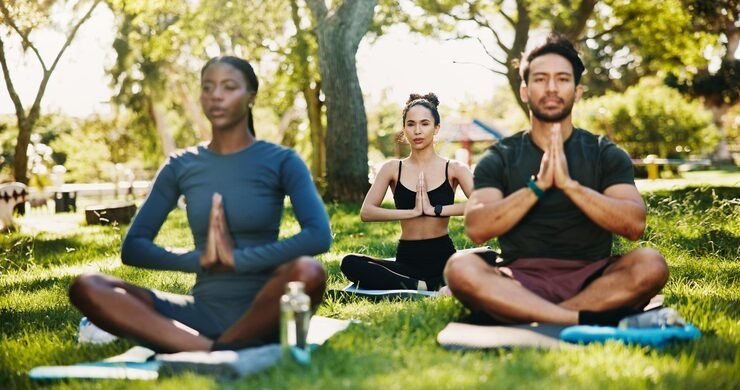
Myth #4: It Has to Look Like Sitting Silently and Still
This is one of the biggest misconceptions, and honestly, one that disconnects a lot of people from practices that are already in their ancestral lineage. Sitting cross-legged in total silence is one form of meditation; it is absolutely not the only form. Meditation is really any state where you enter a kind of flow, where your attention is fully absorbed in what you’re doing and the mental chatter quiets on its own.
That can happen through:
- Movement: yoga, walking, dance, even kickboxing or running, when your attention is fully on your body and breath.
- Sound: chanting, singing, drumming, or simply listening deeply to music, a waterfall, or crystal singing bowls.
- Breathwork: intentional breathing patterns that anchor you in your body and shift your nervous system in real time.
- Guided meditation: following another person’s voice as an anchor, which many people find easier than sitting with total silence.
- Prayer: a practice that, across nearly every culture and tradition, has functioned as a form of meditation long before the word “meditation” entered Western wellness spaces.
Many cultures never separated meditation from movement, sound, or communal ritual the way modern Western wellness sometimes does. If sitting in silence has never worked for you, it might simply mean that isn’t your form not that meditation isn’t for you.
The Real Definition
Strip away all the misconceptions, and meditation is simply this: a practice of returning to presence, observing what’s happening internally without judgment, and remembering that you are the witness of your thoughts, not the thoughts themselves.
However you get there five minutes of breath, a walk in nature, a chant, a dance, or a prayer if you’re present and observing, you’re meditating. There’s no wrong way to come home to yourself. yourself.